Blog

Photon UVC available at Animal Eye Doctors

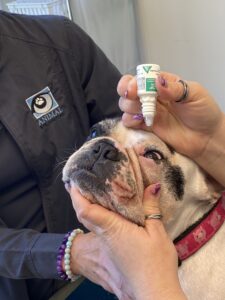
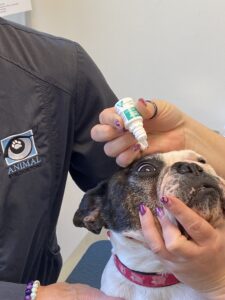
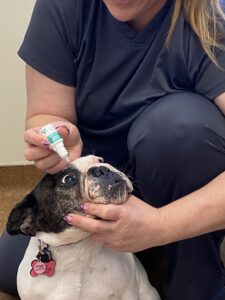
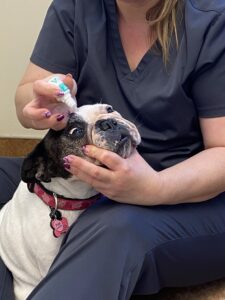
We are excited to announce that Photon UVC (ultraviolet light) therapy is now available at Animal Eye Doctors. This is a new cutting edge technology to treat corneal infections. https://photon-therapeutics.com/

Corneal infections are very common in southwest Florida and can lead to loss of vision in serious cases. Because corneal infections can progress rapidly and unpredictably, aggressive treatment is required. Usually treatment involves intensive application of eye medications or surgery.

The patented Photon UVC technology is a non-contact 5 second treatment that emits low dose UVC ( ultraviolet) light at a targeted area of the infected cornea, deactivating infectious organisms while being safe to host tissues. The device is hand held and the UVC light treats the infected area for a  5 second time duration, making it easy to use on fully awake patients without the need for sedation or anesthesia. The device emits a specific wavelength of ultraviolet light that targets bacterial, viral, and fungal organisms without affecting patient tissue.

Additionally, there is no microbial resistance to UVC light. Furthermore, the effect of the UVC light on the infective organisms is quick with microbial load reduced significantly within 4 hours.

Above all, Animal Eye Doctors has your pet’s best care in mind. We are pleased to add this revolutionary cutting edge technology to our clinic. Call us t0 schedule an appointment.

A logo for animal eye doctor, inc.

Laser Therapy Available at Animal Eye Doctors

Laser therapy is available at Animal Eye Doctors for certain eye conditions and can be an important tool for treatment of your pet.

Eye Conditions where laser therapy may be an option:

  1. Glaucoma: In veterinary medicine, glaucoma is an elevation of pressure in the eye due to too much fluid in the eye. Normally, the eye has an equilibrated inflow and outflow of fluid which brings in nutrients. Glaucoma occurs when there is too much fluid in the eye, causing an elevation of pressure in the eye. A blockage of the drain of the eye, called the drainage angle/ ciliary cleft, will cause glaucoma. The increased pressure damages the retina and optic nerve, causing vision loss. In addition, glaucoma can cause discomfort. Animal Eye Doctors has two forms of laser therapy for glaucoma.  https://wagwalking.com/treatment/cyclophotocoagulation
    1. One form, called endolaser, utilizes a laser on a tiny probe with a camera that is inserted into the eye. The surgeon visualize the structure of the eye that produces fluid and the laser ablates these structures, thereby reducing fluid inflow. The endolaser, however, requires removal of the lens to access the proper tissue.
    2. Trans-scleral photoablation is the second laser procedure for glaucoma. With this procedure, the surgeon applies the laser externally over the ciliary processes without having to enter the eye.
  2. Certain Tumors of the Eye: Certain eye tumors, such as limbal and iridal melanocytomas may be treated with the laser. For these conditions, the surgeon applies the laser externally.
  3. Partial Retinal Detachments: The surgeon may direct the laser through the pupil to address small partial retinal detachments.
  4. Vitreal Degeneration with a Predisposition to Retinal Detachment: Certain breeds of dogs, such as the Shih Tzu, may have an inherited condition called vitreal degeneration. The jelly part of the eye, called the vitreous, is liquified and can therefore cause retinal detachment. The surgeon applies the laser through the pupil to the periphery of the retina. This helps to “tack” the retina in place, decreasing the chance of detachment.

Animal Eye Doctors offers these laser treatment modalities to our clients for the care of their pets. Call us to schedule an appointment.

High Blood Pressure in Aged Cats


High blood pressure in aged cats is common and can affect their eyes and vision. https://www.vet.cornell.edu/departments-centers-and-institutes/cornell-feline-health-center/health-information/feline-health-topics/hypertension

Ocular signs may be the first indication of high blood pressure. These signs can include loss of vision, dilation of pupils, retinal detachment and intraocular hemorrhage. Neurologic symptoms such as disorientation or seizures may also occur.

High blood pressure results in fluid leakage underneath the retina, a thin layer of cells in the back of the eye that is responsible for vision. The retina becomes detached as a result. Lowering of the blood pressure helps reverse this change. When detected early, most patients with high blood pressure will regain partial functional vision. The presence of marked retinal or intraocular hemorrhage or retinal tears decrease the potential for return of vision. In addition, the longer a retina remains detached, the lower the prognosis for return of functional vision.

High blood pressure in aged cats (hypertension) may result from kidney disease, hyperthyroidism, heart disease, hyperaldosteronism, diabetes mellitus, or a combination of these. Kidney disease and hyperthyroidism are the most common causes. Additional work-up can be done by your veterinarian to further help determine the cause.

Blood pressure is measured in cats in a similar way that your blood pressure is checked.  Blood pressure is measured by an ultrasound device (doppler) or an oscillometric device attached to a cuff. A small cuff appropriate to the size of the cat is placed around the limb. Normal systolic blood pressure in cats ranges between 120-150mmHg,  but hypertensive cats can experience blood pressure greater than 200mmHg.

Treatment for high blood pressure in aged cats is dictated by cause but often includes medications.

If you think your cat has eye changes compatible with high blood pressure, call us at Animal Eye Doctors for an appointment. Make An Appointment


Feline Conjunctivitis

Feline conjunctivitis is an inflammation of the pink tissue surrounding the eyes of cats. Signs of feline conjunctivitis include redness, swelling, tearing , and squinting of the eyes. https://www.dvm360.com/view/feline-conjunctivitis-a-cat-is-not-a-small-dog-

Though feline conjunctivitis can accompany other eye diseases, conjunctivitis in cats is often caused by an infectious agent. These agents include bacteria and virus: Mycoplasma, Chlamydia, Bordetella, Feline Herpes Virus, and Caliciviris. In addition to conjunctivitis, these agents can cause upper respiratory signs (coughing, sneezing, nasal discharge).

Herpes virus infection can cause conjunctival inflammation and edema and corneal inflammation. Feline herpes virus is an exceptionally common viral infection of cats with nearly all cats having evidence of exposure to the virus.

Herpes can also cause corneal ulcers as well as ulcers of the mouth, nasal tissue, and skin. Herpes ulceration can sometimes lead to sequestrum formation (a focal area of dead corneal tissue that takes on a brown color).

Feline Herpes virus does not affect people or other species of animals (just cats). It is transmitted via aerosol (respiratory route). Herpes virus infection can not be cured, but can be put into remission (carrier state). Cats in a carrier state can still shed the virus intermittently, however. Our goals with acute herpes virus infections are to put the virus into remission, prevent secondary bacterial infections, and minimize discomfort.

Calicivirus can cause conjunctivitis in cats, but the disease is most often self-limiting.

Chlamydia is a bacteria that can cause conjunctivitis in cats and other animal species including people, so be aware and wash your hands after handling the pet. The disease is treated with antibiotics.

Mycoplasma is also an infectious bacteria-like agent that has been found in cats with conjunctivitis. This disease is treated with antibiotics. The organism has a low potential to infect other species, so best to be safe and wash your hands after handling an infected pet.

Bordetella can infect dogs and cats. Coughing, sneezing, and conjunctivitis are frequent symptoms of the disease.

A swab of the conjunctiva can be sent in to a lab for DNA testing (PCR) for the infectious agents. Sometimes false negatives can occur, however, if not enough DNA is obtainable on the sample.

In addition to infectious diseases, conjunctivitis may be inflammatory (immune response) or allergic (environment, food etc). These types of feline conjunctivitis require anti-inflammatory eye medications. Eye discharge can also occur with dental disease.

If you think your pet has feline conjunctivitis, call us to schedule an appointment. Make An Appointment

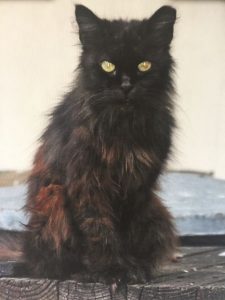
A black cat sitting on top of a table.

Keeping Your Pet’s Eyes Clean

It is important to keep your pet’s eyes clean and face well-groomed for eye health. Overgrown hair not only obstructs an owner’s view of the pet’s eyes (you may miss an eye problem if you cannot see the eyes) but also carries bacteria and dirt, increasing the risk of infection. Overgrown hair also can be irritating to the eyes when direct contact is made. Crusts on the eyelids can harden and scratch the eyes.

There are a number of veterinary products that are made to clean pet’s eyes safely. A few that I like include:

-Optixcare Wipes by Aventix. These are packaged towelettes pre-moistened with a safe and gentle formulation of chamomile and hyaluron  https://www.aventix-international.com/optixcare-eye-cleaner-wipes

-I-Lid and Lash by I-Med: This product comes in wipes or a pump bottle and contains hyaluron and glycerin  https://imedpharma.com/product/i-lid-n-lash-sell-sheet/

-A clean, warm, wet washcloth or cotton pad can be applied to the eye for 5—15 minutes, 2—4 times daily.  The warmth will soothe and relax muscles and bring healthy blood supply to the area.  This will help to soften dried mucous and crusts and will allow you to slowly remove debris from the area.

To keep your pet’s eyes clean, work slowly and allow the crusts and debris to moisten and soften, to allow for ease of removal. You may apply light pressure to the bone around the eye but never press on the eyeball itself. Do not touch the eyeball with the cloths or wipes. Work around the eye.

Furry pets and pets with short noses (such as the Shih Tzu) need regular grooming. It is important to keep the hair (the ruffle) on the bridge of the nose clipped short, as this hair often contacts the eyes if left long.

Keeping your pet’s eyes clean will not only make them look better, but will also keep their eyes healthier.


Care of a Visually Impaired Pet: Animal Eye Doctors

Care of a visually impaired pet may at first seem over-whelming, but with a little information and with a little time, most find that they and their pets accommodate well. Keep in mind that pets have an acuity of senses other than vision that we do not have and may not appreciate (ie: smell, taste, hearing). They use these acute senses to accommodate to visual loss.
If your pet has experienced a sudden loss of vision, there will be initial confusion, but given time (3-8 weeks), most pets will memorize their surroundings and use other cues for localization. It will be helpful to keep their surroundings constant. Pets that lose vision slowly adjust more easily, doing so with the gradual visual change.
A visually impaired pet can have a very good quality life and is happy pet with your loving help and reassurance.

Below are some helpful guidelines from Animal Eye Doctors for care:
1) Be supportive while your pet memorizes the surroundings. Your pet will learn as they navigate. Make their navigation safe by removing or barricading dangerous obstacles such as stairs and pools. Keep your pet (dog) in a fenced area when outdoors (no open roadsides, no unfenced pools, etc). A pet cat would do best kept indoors.
2) Some pets will benefit from the use of a hoop on a harness (see handout) that will act as a “bumper” when they are learning to navigate.
3) Utilize their other senses (smell, touch, hearing). Use scents such as perfume or scented oil to identify different areas. Use different textured rugs, runners, or flooring. A soft playing radio or TV in certain areas can also help them with locale.
4) Consider the use of the “Safety Turtle”, if you have a pool. This monitor attaches to a collar or harness and if wet, an alarm will sound from a monitor.
5) Approach your pet slowly while speaking, to avoid startling your pet.
6) Encourage play with toys that make noise or toys with a scent (toys in which you can place a treat that the pet can smell). One of my patients born visually impaired was able to catch a ball in mid-air by listening.
7) Use a harness to provide more support while walking your pet, rather than a neck collar. A sign on the harness to indicate that your pet is blind will alert other people to not startle your pet. Walk a routine path to allow your pet to memorize the way.
8) Use verbal cues. Pets will memorize words. For example: stop, start, up, down, curb, etc. One of my clients taught his pet over 100 words and directional cues.
9) Pets with low vision may do better with lights on or the use of night lights at night.
10) Some pets will follow your other pets for guidance. Keep in mind, however, that the visual pet may become aggressive with a visually impaired pet, or your visually impaired pet may be more defensive with other pets.

Contact Animal Eye Doctors for helpful advice in care of a visually impaired pet.

Also, check out the websites: Blindtails.com and BlindDogsSupport.com


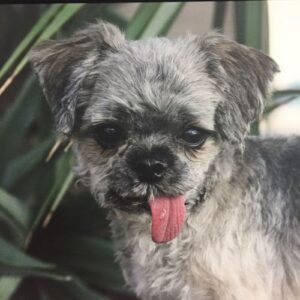
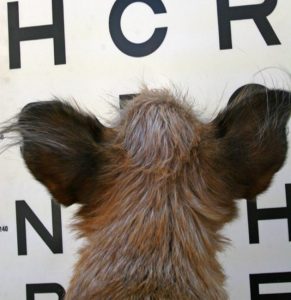
A dog with long hair looking at the letters on the wall.

Animal Eye Clinic

Animal Eye Doctors is an established provider of pet eye care in the Fort Myers/ Naples, Florida area since 2007. What is an animal eye clinic? How is this different from a general veterinary practice?

To begin with, board-certified or board-eligible veterinarians make up veterinary ophthalmic specialty practices. Board-certified doctors are diplomates of a specialty organization. In the North America, this organization is the American College of Veterinary Ophthalmologists. You may see the letters DACVO after the name of a boarded doctor. This stands for “Diplomate of the American College of Veterinary Ophthalmologists”.

To become a board-certified member of the ACVO, a veterinarian must complete a 3-year or longer residency training program in veterinary ophthalmology at a university or accredited private practice.  After training, the applicant takes a multi-day test that consists of written and surgical components. A veterinarian is recognized as a “Diplomate of the American College of Veterinary Ophthalmologists®” (or board certified) with successful completion of the examination. Only board-certified persons may call themselves a “veterinary specialist”, a “specialist in veterinary ophthalmology” or a “veterinary ophthalmologist”.

Why consider a veterinary ophthalmologist and an animal eye clinic? A general practice veterinarian may handle many eye problems. However, patients may benefit from the skills and experience of a specialist. In these cases, a general veterinarian can make a referral to a veterinary ophthalmologist.

Clients may also contact an ophthalmologist directly if they wish. Referrals are not required as they are in human medicine.

The following might be situations to consider consultation with a veterinary ophthalmologist:

  • Your pet’s eye condition has not responded to the recommended therapy.

  • Your pet’s vision seems to be deteriorating despite treatment efforts.

  • A corneal ulcer has not responded to treatment.

  • Cataracts causing visual impairment.

  • Breeders who want to ensure their animals have no inherited ocular disease

For more information on animal eye clinics and doctors, you may check out the ACVO website.

Pet Eye Clinic in Southwest Florida for OFA Eye Exams


The board certified ophthalmologists at Animal Eye Doctors pet eye clinic in Southwest Florida provide OFA certification eye exams.

OFA Eye Certification examinations are screening exams performed by board-certified veterinary ophthalmologists. The OFA Companion Animal Eye Registry (CAER) provides breeders with information regarding canine eye diseases so that they may make informed breeding decisions in an effort to produce healthier dogs.

The Eye Certification exam consists of indirect ophthalmoscopy and slit lamp biomicroscopy. It is not a comprehensive ocular health examination, but rather an eye screening exam. Before the  exam, the eyes are dilated with eye drops. Following the examination, the board-certified veterinary ophthalmologist will complete the OFA Companion Animal Eye Registry (CAER) form and indicate any specific disease(s) found.

The exam will generate one of three results: Pass and eligible for certification, Breeder Option but eligible for certification, and No and not eligible for certification.

Two categories of advice regarding breeding have been established by the Genetics Committee of the ACVO:

  • NO: Substantial evidence exists to support the heritability of this entity AND/OR the entity represents a potential compromise of vision or ocular function.
  • BREEDER OPTION: The eye condition is suspected to be inherited. However, it does not represent potential compromise of vision or other ocular function. Although the dog will pass it will have additional documentation on its OFA Eye Certification number with a category listing the problem.

If the breeding advice is NO, even a minor clinical form of the entity would make the animal unsuitable for breeding. When the advice is BREEDER OPTION, caution is advised.

10 inherited eye conditions will trigger a “No” breeding recommendation. Generally, individuals with one or more of these conditions will not be eligible for OFA certification:

  1. Keratoconjunctivitis sicca (KCS)
  2. Cataract Breeding is not recommended for any animal demonstrating partial or complete opacity of the lens or its capsule unless the examiner has also checked the space for significance of above cataract unknown or unless specified otherwise for the particular breed.
  3. Lens luxation or subluxation
  4. Glaucoma
  5. Persistent hyperplastic primary vitreous (PHPV)
  6. Retinal detachment
  7. A dog that is looking at the camera.Retinal dysplasia geographic or detached forms
  8. Optic nerve coloboma
  9. Optic nerve hypoplasia
  10. Progressive Retinal Atrophy (PRA)


The OFA exam may be supplemented by genetic testing for specific ocular diseases if available.

More information concerning OFA Companion Animal Eye Registry (CAER) can be found at the OFA website . You may also contact Animal Eye Doctors, a premiere pet eye clinic in Southwest Florida at 239-948-3937.

Help! My Pet Has Lost Vision!


Help! My pet has lost vision! Information from Animal Eye Doctors serving Fort Myers and Naples to help you and your pet.

Visual impairment may be caused by conditions affecting different parts of the eye.A dog wearing goggles and harness sitting on the floor.

Cornea:

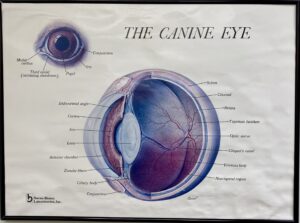
The cornea is the “windshield” of the eye. Conditions that disrupt corneal tissue can affect clarity and therefore, vision. Scar tissue from previous injury can obscure vision. Pannus, common to German Shepherds, is a disease in which fibrovascular tissue covers the cornea. Short nosed pets with prominent eyes, such as Pugs, Pekingese, and Shih Tzus, can develop pigmentation of the cornea as a response to inadequate eyelid protection. Corneal edema, or fluid in the corneal tissue, will give the cornea a cloudy appearance, like a foggy windshield. Whenever these conditions occur, a decline in vision occurs.

Lens:

The lens of the eye is a clear round structure inside the eye used to focus. A cataract is an opacity inside the lens. Small cataracts may have minimal affect on vision, though large cataracts can cause vision loss. Genetic cataracts can occur in young dogs. Diabetes mellitus may cause full cataracts, also causing complete vision loss.

Retina:

The retina functions as the film in a camera. Inflammation or detachment of the retina will decrease vision because retinal function declines. Genetic retinal diseases such as Progressive Retinal Atrophy (PRA) occur in many breeds and can cause loss of rod/cone function (retinal cells), eventually causing a slow loss of vision. Another retinal disease, called Sudden Acquired Retinal Degeneration Syndrome, causes a more rapid loss of vision in middle aged to older dogs. High blood pressure in aged cats can cause retinal bleeding and detachment.

Optic Nerve and Brain:

The optic nerve connects the eye to the brain (like an electrical cord). Autoimmune conditions, infections, tumors, or injury can damage the optic nerve and cause a disruption of transmission of images from the eye to the brain. Glaucoma, a condition of increased intraocular pressure, can cause vision loss by damaging the optic nerve. Additionally, cerebral injury, inflammation, or infection can affect the visual center of the brain and result in vision loss.

My pet has lost vision! If your pet shows visual impairment, please call for an appointment with the veterinary ophthalmologists at Animal Eye Doctors serving Fort Myers, Estero, Naples, and  Southwest Florida to evaluate your pet. A number of conditions causing vision loss can be treatable and lost vision may be regained.


Warning Signs of a Pet Eye Emergency: Advice from a Pet Ophthalmologist in Fort Myers/ Naples

A cat is being petted by someone in the background.

When should one seek advice from a pet ophthalmologist? What are the warning signs of a pet eye emergency? 

Eye problems in pets are serious and should never be ignored. Unfortunately, many pet parents are not aware of the warning signs of pet eye emergencies. At Animal Eye Doctors, we always advise bringing your pet in at the first sign of a problem involving their eyes or vision. In addition, however, there are several warning signs that require an immediate exam from a pet ophthalmologist in Fort Myers/ Naples. Keep reading to learn more about some symptoms you should never ignore. Continue reading

Our veterinary ophthalmology specialty practice serves southwest Florida with offices conveniently located in Estero and Naples and office hours Monday through Friday.